A Neuroaffirming and Disability Inclusive Guide to Halloween Events
Halloween is becoming a familiar part of the community calendar in many parts of Australia, including our regional and remote communities. Some families love the costumes, neighbourhood visits and creative events; others do not celebrate, for cultural, faith or personal reasons. Both choices deserve respect.
When a community does host a Halloween event, we have an opportunity to think carefully about who can take part and what the experience asks of them.
A welcome on a poster is a beginning, but families need to know what will happen after they arrive.
Can everyone find and use the entrance, the activity and the toilet?
Will someone know how to respond if a visitor communicates without speech?
Can a person enjoy the excitement, take a break and return, or decide that they have had enough?
These are the everyday details that turn a community invitation into an experience more people can actually choose.
A neuroaffirming approach recognises that people experience sensory input, uncertainty and communication in many different ways. Being sensory friendly does not mean that every activity must be low light, no noise or feel the same to everyone.
It means giving clear information, offering different ways to join in, and making it possible to change course when the experience no longer feels right.
Disability inclusion asks us to also extend that thinking to physical access, safety and how people are welcomed and accepted by others.
Why Halloween can ask more of a visitor than we realise?
Halloween brings together things that many people enjoy: music, costumes, decorations, darkness and a little suspense. But, it can also bring sudden screams, flashing lights, unfamiliar smells, crowded paths and people whose faces are hidden by masks.
A neurodivergent person may experience some of this sensory information intensely or need more time to work out what is happening around them. For a person managing pain, fatigue or a physical disability, the effort of travelling, waiting and moving through a busy venue may already have used much of their capacity before the main activity begins.
The cumulative impact of all of these experiences may mean, someone who enjoys a spooky attraction may be comfortable with its sounds at the start, then find the same sound much harder after a long queue and a confusing change of plan. Another person may actively seek a strong scare and want to experience every part of it.
There is no single “sensory friendly” version that describes what all disabled or neurodivergent visitors want. The more useful question for organisers is whether people can understand what is coming, choose how they would like to participate and be able to access support when their needs change.
1.Give families information they can use before the event
Families often have to make access decisions before leaving home. An event description that says “fun for all ages” cannot tell a visitor whether there are loud effects, actors who jump out, a dark maze or a twenty-minute wait in the sun.
Where possible, share;
the age range and level of scare,
the likely length of activities and queues,
costs,
parking and drop-off,
step-free routes,
accessible toilets,
food options,
photography
and a contact for access questions.
Also state where a person can watch first, find a quieter space or leave an activity early. If a particular effect cannot be avoided, make that clear so the person can decide whether it works for them.
Best Practice: Make this information available as readable website text, alongside posters or social images, and add captions and a written description to any preview video.
At the entrance, a simple “what to expect” board can show the order of activities, examples of what visitors might see or hear, and where the exits are.
A family can then talk through the event together, use the information with a communication system, or plan a shorter visit. Sharing the type of surprise does not require giving away the exact moment it happens.
Last year, we worked with our local youth centre as its talented team created an age-appropriate haunted house that was still genuinely scary. We considered a “what to expect” board outside the tent, with examples of what (scares) could be inside, and simple directions such as “Follow the line” and “If it gets too much, you can find an exit next to the X.” We also provided headphones and torches at the entrance for a more sensory friendly experience.
This is just one example of how a creative event can give visitors information and choices while keeping the experience they came for.
2. Make the whole event easier to move through
It helps to walk the activity route as a visitor would - starting at the car park or drop-off point and continuing through the queue, activity, toilet, rest area and exit.
A ramp at the front may lead to gravel, a narrow turn or a cable across the path.
A quiet space may be marked on the map but placed next to the speakers.
An accessible toilet may be locked or used for storage.
These details are easy to miss during setup and hard for a visitor to solve in the middle of an outing.
Check the route after dark as well as in daylight, and ask disabled people in your community to review it with you before the event opens.
Think about the waiting as carefully as the attraction. Seats, water and a way to return to a queue can help visitors managing heat, fatigue, pain or mobility needs, especially in a Pilbara spring.
Make a lower-sensory place easy to find and genuinely quieter, with a usable seat and access to water.
If your event can offer a quieter session, a shorter route or an option to watch before entering, explain those choices in advance so families can plan around them.
The team’s response is also part of access.
Volunteers should know where the accessible exits and toilets are, how to pause an activity, and how someone can ask for help. They should not block a visitor’s route or use unexpected touch as part of a scare.
Check that signs can be seen in low light, avoid strobe lighting, and explain any smoke, scents or other effects before entry.
When a visitor wants to stop, the response should be to help them do so promptly, without asking them to justify their decision while the experience continues around them.
3. Welcome every way a person communicates
A Halloween event is full of quick interactions: asking for a treat, choosing an activity, telling a volunteer that something is too loud or finding the way out.
A person who does not use verbal speech, who may need more time to process and respond, or who finds communication harder in a noisy space should have access to additional ways to communicate their wants and needs.
At a busy doorstep, for example, requiring a child to say “trick or treat”, make eye contact and choose a lolly quickly can make a simple moment inaccessible. Showing the choices available, waiting for an answer and responding to the person’s preferred form of communication changes the experience, and enables them to participate indepentently and comfortably. .
Augmentative and Alternative Communication, or AAC, describes ways of communicating with or instead of speech. These may include gestures, signs, picture or word boards, a communication book or a device that speaks selected words. A person might use several of these methods, including speech, at different times, in different environments and contexts.
Staff and householders should;
speak directly to the person,
give them time to process and respond,
accept a point or device message as a response,
and ask a supporter for help only in a way that respects the person’s choice.
Communication boards, are low tech AAC options, that can provide useful words and symbols on one board, where an interaction is happening, such as at a welcome table, treat station or attraction entrance.
Volunteers can point to a symbol while speaking and leave the board within the visitor’s reach.
A Communication board adds an option for the wider community; it does not replace a person’s own device, book, signs or other established way of communicating.
Making room for these different ways of expressing a choice is part of neuroaffirming practice, whether a visitor is asking to join in, take a break or leave.
4. Tips for families planning an outing
If your family is considering a Halloween event,
look for the additional information that will help the person to understand what to expect when they get there.
You might view the photos or event map together, talk through what happens from arrival to leaving, and ask the organiser about effects, access or quieter options that are not explained online.
You may also discuss and agree on a comfortable starting point and a way to take a break or head home.
A costume can be a favourite outfit, a small accessory or no costume at all; think about comfort, movement and visibility as well as the theme.
Bring the person’s usual communication supports and any tools they choose, such as headphones, water or a torch.
For neighbourhood trick-or-treating,
choose a manageable route among homes that clearly indicate they are participating, and respect those that are not.
Plan who will stay with children, where you will meet if separated, and how you will cross roads and driveways safely. Use footpaths and crossings where available.
As it gets dark, a torch or reflective detail can make costumes easier for drivers to see; check that masks or headwear do not obscure a child’s view.
If a child may move away quickly when excited or distressed, agree on a plan that fits their communication and support needs before you set out.
Once you are there,
notice what the person is enjoying and what might be building up for them.
A break, a change of activity or an early finish can be part of a good evening.
Check ingredient labels when food allergies are relevant, keep treats for later if that suits your family,
and ask before anyone takes or shares photographs.
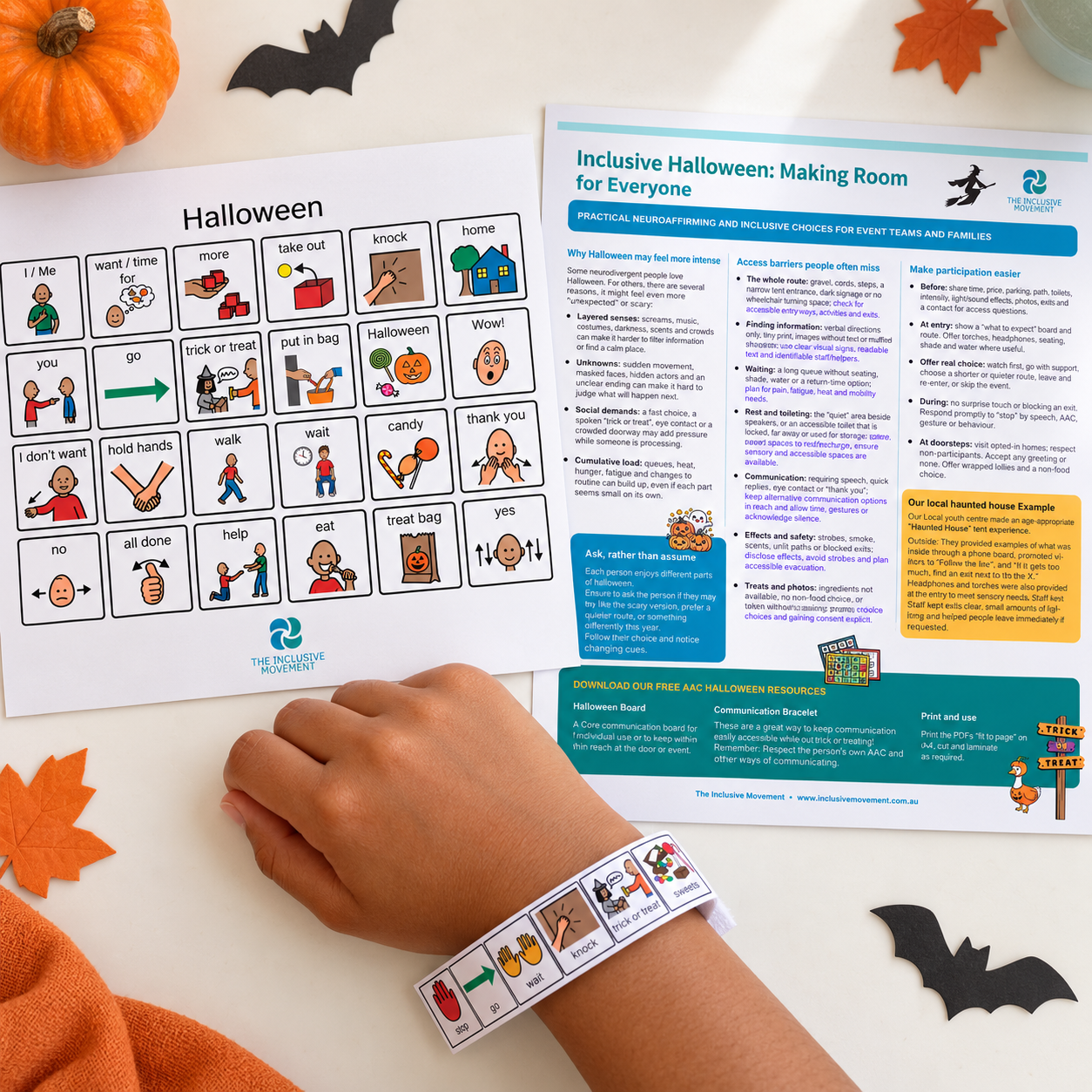
Download our Free Halloween communication resources for families and community groups
To help put communication access into practice, we’ve bundled our free Halloween Communication Board, an optional cut-out Communication Bracelet and a one-page guide for families and community groups.
Families can take the board on an outing or use it to talk through choices in advance.
Community groups can print copies for volunteers, welcome areas and activities.
These resources should be used alongside the person’s own AAC, if available, and support two way communication.
Download the free pack, share it with the people planning your event and invite local disabled and neurodivergent community members to help shape what happens next.
A more inclusive Halloween grows from those conversations.
Halloween is a chance for families and communities to connect, and everyone needs a way to understand, choose and communicate during the experience.
What you will find inside:
Halloween Communication Board (one-page landscape PDF)
Halloween Communication Bracelets (print, laminate, velcro) - great for accessible communication options while trick or treating.
Inclusive Halloween One-Page Guide (one-page A4 landscape PDF): a practical reference on sensory load, hidden access barriers, communication and choice for event teams and families.