AAC Awareness Month 2026
Communication Access in Action
Communication access is everyone’s responsibility.
This October, join The Inclusive Movement for four practical weekly missions designed to make communication more available, respected and embedded in everyday life.
Whether you are a family member, educator, therapist, support worker, employer, service provider or community organisation, there is something meaningful you can do.
You can start at any point during October. Choose one action or work through the full campaign.
Communication happens in many ways
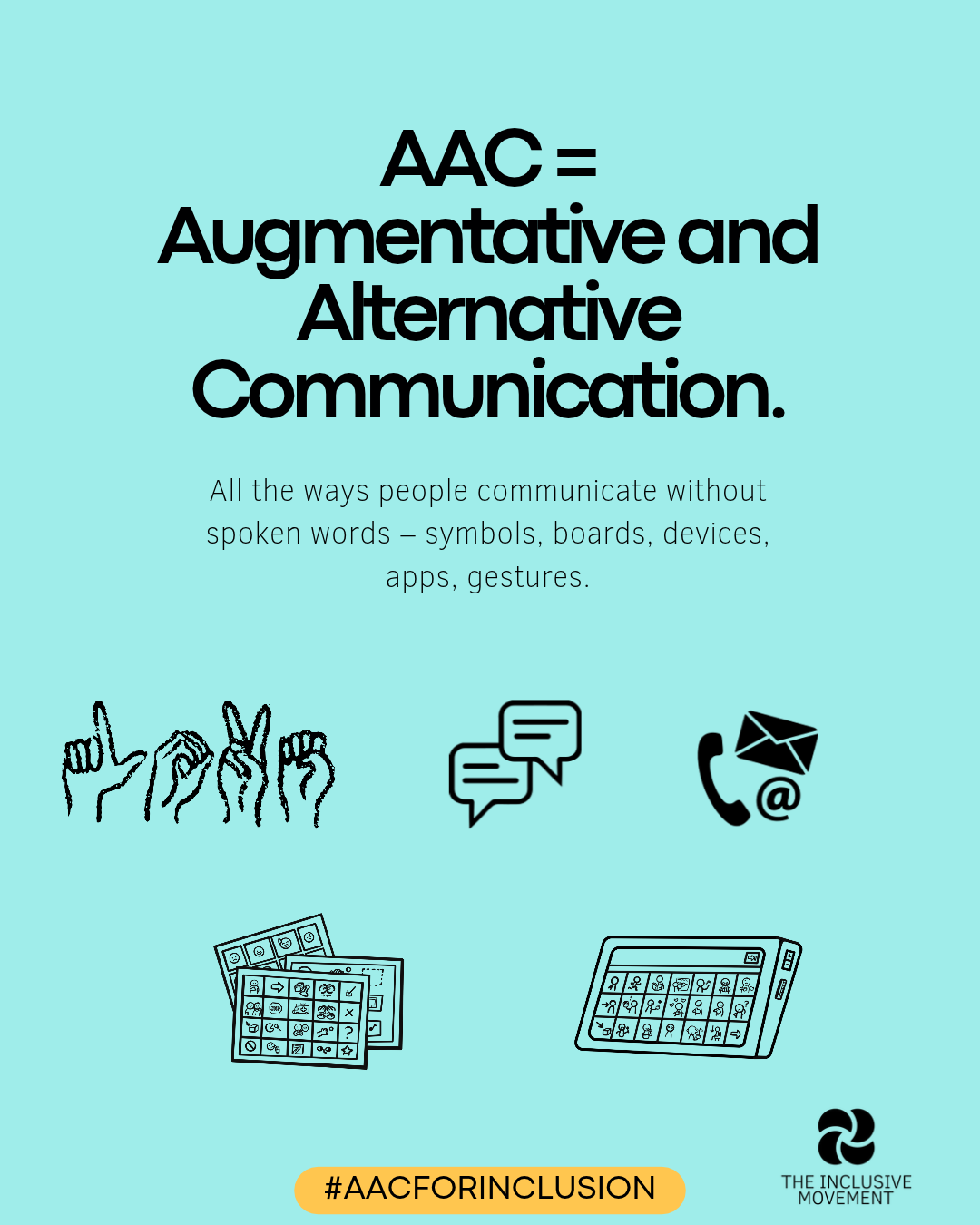
AAC stands for augmentative and alternative communication.
AAC includes tools, strategies and communication modes that supplement speech or provide an alternative to speech. It may include:
gestures and movement
facial expressions
signing
objects, photos and symbols
writing and drawing
communication books and boards
typing
communication apps
speech-generating devices
support from a trusted communication partner
Many people use several forms of communication together. The way a person communicates may also change depending on their environment, health, energy, sensory needs, communication partner or the topic being discussed.
Every form of communication deserves to be noticed, respected and responded to.

2026 CAMPAIGN THEME
AAC in Everyday Life: Today, Tomorrow, and Beyond
The international theme for AAC Awareness Month 2026 invites us to recognise AAC as part of everyday life—not something that belongs only in therapy sessions, classrooms or formal activities.
AAC should be available wherever people live, learn, work, connect, make decisions, have fun and participate in their communities.
Our 2026 campaign, Communication Access in Action, turns this theme into four practical weekly missions.
The goal is not simply to increase awareness during October. It is to make at least one change that remains in place after the campaign ends.
Awareness can begin the conversation. Accessible systems keep it going.

This is an access challenge—not a simulation
This campaign does not ask participants to stop speaking or imitate the experience of someone who uses AAC.
No short-term simulation can recreate another person’s communication experiences, relationships, access barriers or expertise.
Instead, we invite you to look carefully at the environments, systems and communication habits around you.
Ask:
Is the person’s communication system available?
Are we allowing enough time?
Are we noticing every communication mode?
Are there different ways to participate?
Are people being responded to—or tested?
What environmental or organisational barrier could we change?
The most meaningful awareness comes from listening to AAC users, respecting lived expertise and taking practical action.
Choose how you would like to take part
There is no single correct way to participate. Choose a pathway that is realistic for you, your family, team or organisation.
Start

Choose one weekly mission and make one practical change.

This may be as simple as checking whether AAC is within reach, allowing more response time or adding a written contribution option to your next meeting.
Build
Complete all four missions and use the campaign tools to review communication access across your home, classroom, service, workplace or community group.
Invite other people to participate and compare what you notice.Embed
Choose one recurring barrier and build the solution into an everyday system.
Name the change, identify who owns it, resource it properly and set a date to review whether access has improved.
Where possible, co-design the change with the people affected by it.WEEKLY MISSIONS
Four weeks of Communication Access in Action
You can follow the missions in order or begin with the one that is most relevant to your setting.
There is no need to “catch up”. Each mission can create meaningful change on its own.

-
A communication system cannot support participation if it is in another room, switched off, uncharged, poorly positioned or treated as something that is only needed during therapy.
This week, check:
Is the person’s AAC available in every place they participate?
Can they comfortably reach, see, hear or access it?
Is the system charged and working?
Is there a backup option?
Does useful vocabulary reflect what is happening now?
Do the people nearby know how to support access without taking over?
Is the person’s system available during informal, social and enjoyable moments—not only when they are being asked a question?
Ask the AAC user and the people who know their communication well what would make access easier.
This week’s action:
Choose one place or routine and remove one practical access barrier. -
Communication can take time.
Some people need additional time to process what has been said, plan a response, navigate a communication system, coordinate movement or decide whether they want to respond.
Repeating the question, changing the wording or moving on too quickly can restart that process.
This week, practise:
slowing the pace
pausing after asking a question
keeping your attention available
noticing gesture, facial expression, movement, AAC, writing and other modes
responding to the meaning of the message
checking what you understood
repairing misunderstandings together
respecting refusal, silence and changes of mind
AAC is communication—not a test.
Modelling AAC can show possibilities, but it should not create a demand for the person to copy, perform or provide a particular answer.
This week’s action:
Choose one communication-partner habit to practise consistently. -
Participation should not depend on speaking quickly, processing information immediately or communicating in one expected way.
This applies in homes, schools, services, meetings, workplaces, appointments, events and community spaces.
This week, make different participation options visible.
People might contribute through:
speech
AAC
typing or chat
writing
drawing
pointing
gesture
a support person
prepared information
a private response
a response provided after the activity or meeting
Offer these options from the beginning rather than waiting until someone appears to be struggling.
This week’s action:
Choose one meeting, activity, appointment or event and provide at least three ways to participate. -
Awareness matters most when it leads to a change that remains.
Choose one policy, process, routine, template, space or piece of infrastructure that repeatedly affects communication access.
Examples might include:
adding communication preferences to intake forms
including participation options in meeting invitations
sharing agendas in advance
keeping communication boards available in community spaces
creating charging and backup procedures for AAC
providing alternatives to telephone contact
adding written and visual information to training
improving how people can provide feedback or make complaints
including communication access in event-planning templates
reviewing recruitment and interview processes
Name the barrier in specific terms. Then identify:
the change you will make
who needs to be involved
who will be responsible
what resources are required
when the change will begin
when it will be reviewed
how people affected by the change will provide feedback
This week’s action:
Choose one change that will still be visible on 1 November.
Download the free campaign resources
Use the complete resource pack or select the individual tools that are most relevant to you.
Campaign Poster
Display the Communication Access in Action campaign in your workplace, school, service, organisation or community space.
Bring the campaign into your organisation
Communication access is relevant across every part of an organisation—from first contact and recruitment through to meetings, service delivery, customer support, feedback and complaints.
Your team could participate by:
selecting one mission for each week
using the access audit in a shared environment
reviewing a meeting or intake process
placing communication supports in relevant spaces
discussing communication-partner practices at a staff meeting
inviting people with lived experience to review a proposed change
adding one communication-access commitment to an existing action plan
setting a November review date before the campaign ends
Avoid placing responsibility for the campaign solely on the person who uses AAC or the staff member with disability expertise.
Communication access is a shared organisational responsibility.
LEARN MORE
-
Communication access is shaped by what is available, how much time people are given, whether every mode is respected and how environments are designed.
Read More -
Explore how modelling, waiting and responding genuinely can support communication without turning every interaction into a performance or assessment.
-
Practical changes for recruitment, meetings, training, customer service and everyday workplace communication.
-
Learn how to turn one month of attention into a practical, owned and reviewable change that remains.
FAQs
Do I need to know a lot about AAC to participate?
1
No. The campaign is designed for people at different stages of understanding.
Begin by listening, noticing barriers and taking one practical action. If you support a particular AAC user, follow their preferences and the guidance of people who understand their communication system.
5
6
Do I have to complete all four missions?
2
No. One meaningful and sustainable change is more valuable than rushing through every activity.
You can select one mission, complete the full challenge or use the campaign as the beginning of a longer communication-access project.
Is AAC only for people who do not speak?
3
Should we replace a person’s AAC with the campaign boards?
No. AAC may supplement speech or provide an alternative to speech.
People may use AAC all the time, in particular situations or alongside speech, gesture, signing, writing and other communication modes.
Does using AAC prevent speech development?
4
What does good communication-partner support look like?
AAC provides access to communication. It does not need to be withheld while waiting for speech.
Communication access should not depend on a person first demonstrating a particular skill or level of understanding.
Individual assessment and support should be provided by appropriately qualified professionals where required.
No.
The campaign boards are general communication supports for particular environments or situations. They are not comprehensive or personalised systems.
A person’s own AAC should remain available. Always respect their established vocabulary, access method and communication preferences.
It may include:
making AAC available
modelling language naturally
allowing response time
noticing every communication mode
responding to meaning
checking understanding
repairing misunderstandings together
avoiding repeated testing or prompting
respecting refusal and changes of mind
The individual AAC user remains the most important source of information about what respectful support looks like for them.
ABOUT THE INCLUSIVE MOVEMENT
Practical inclusion that can be seen and felt
The Inclusive Movement provides training, consulting and practical resources that help workplaces, services and communities move from inclusive intentions to meaningful everyday action.
Our work is grounded in:
disability inclusion
neuroaffirming practice
communication access
lived-experience-informed design
dignity, autonomy and consent
practical environmental and systemic change
We support organisations to examine the systems around people—not simply expect individuals to work harder to fit inaccessible environments.
