Risk Management Through Inclusion: Why Inclusive Practice Is Good Risk Management
Inclusion is not simply a values-based conversation. It is a long-term risk management strategy that strengthens wellbeing, participation, sustainability, and community resilience.
Across disability, education, health, and community sectors, many organisations are currently operating in a heightened state of “risk management.”
With ongoing NDIS reforms, the introduction of Thriving Kids, workforce shortages, funding uncertainty, and increasing system pressures, businesses and services are being asked to make difficult decisions about resources, access, staffing, and support delivery.
At the same time:
Schools are managing behavioural, safety, staffing, and compliance risks.
Providers are managing financial sustainability, audits, workforce pressures, and liability concerns.
Families are managing exhaustion, advocacy demands, uncertainty, and fear of losing essential supports.
Disabled and neurodivergent individuals are often navigating systems that were never designed with accessibility and inclusion in mind.
In many spaces, “risk management” has become the dominant lens through which decisions are being made.
But there is an important conversation we need to have as a sector:
What if genuine inclusion is actually one of the most effective forms of long-term risk reduction?
When Risk Management Becomes Reactive
When systems become overwhelmed, there can be a tendency to move toward reactive approaches:
reducing flexibility,
tightening access,
increasing compliance,
limiting participation,
or excluding individuals perceived as “high risk.”
We are seeing this across many environments:
students being excluded from classrooms,
families feeling alienated from schools,
services narrowing eligibility,
individuals losing access to preventative supports,
and parents carrying increasing levels of advocacy and caregiving pressure.
While these responses may reduce short-term pressure for organisations, they often increase long-term risk for individuals, families, and communities.
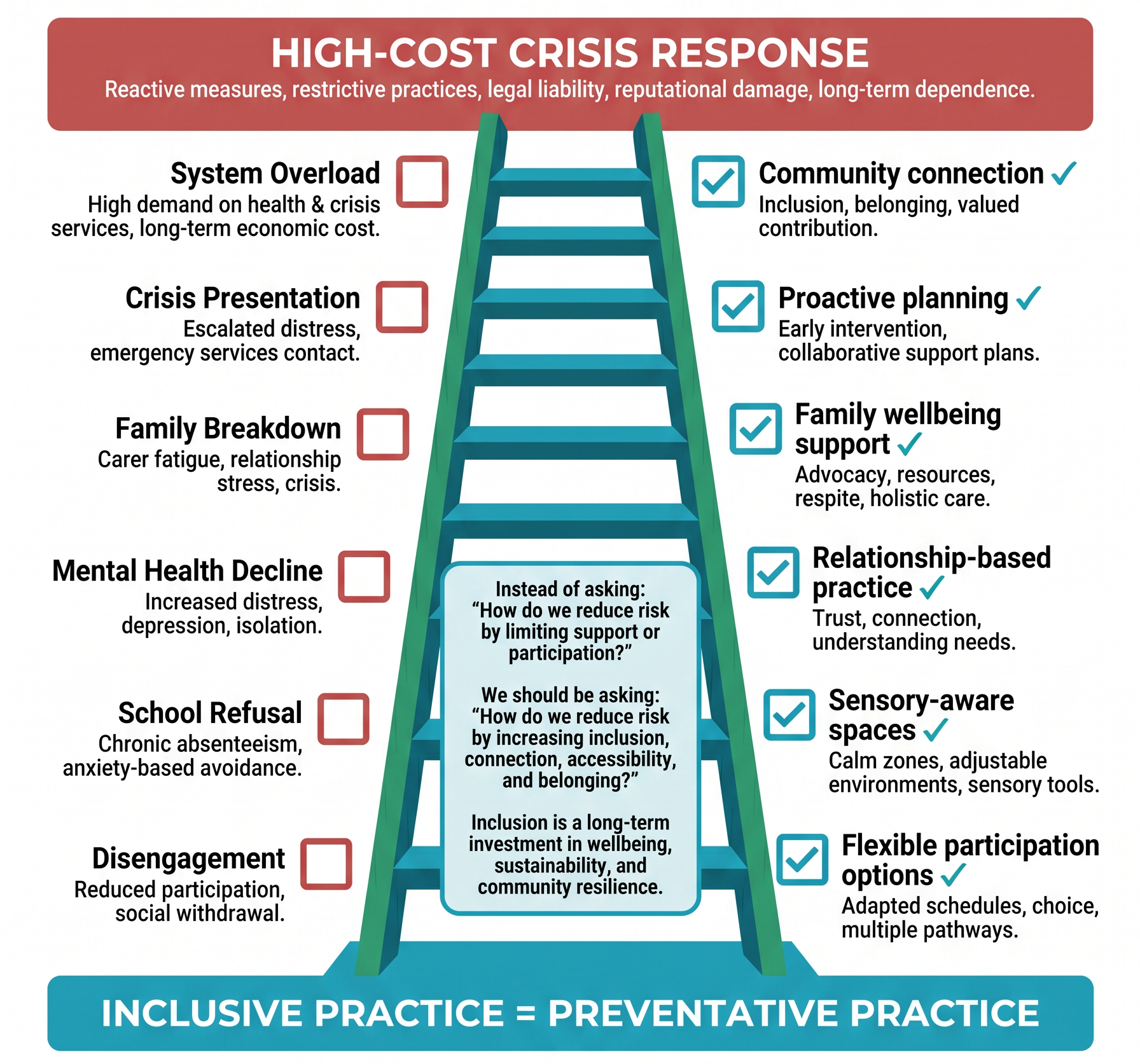
Reactive systems can unintentionally contribute to:
mental health decline,
school refusal,
burnout,
crisis escalation,
family breakdown,
reduced economic participation,
social isolation,
and increased reliance on emergency or crisis services.
The reality is:
exclusion rarely removes risk — it often transfers it elsewhere.
Inclusion Is Risk Reduction
Genuine inclusive practice reduces risk before it escalates.
When businesses, schools, services, and communities plan for inclusion from the beginning, they create environments that are safer, more sustainable, and more responsive for everyone.
Inclusive practice helps reduce the likelihood of:
distress-based behaviours,
crisis presentations,
complaints and conflict,
workforce burnout,
disengagement,
restrictive practices,
reputational damage,
and long-term system strain.
This is because inclusive environments are designed with human needs, accessibility, flexibility, and belonging in mind.
Inclusion is preventative practice.
What Inclusive Risk Management Looks Like
Proactive Planning
Inclusive organisations intentionally build systems that support participation from the beginning.
This may include:
accessible environments,
flexible participation options,
sensory-aware spaces,
predictable routines,
communication supports,
visual information,
and collaborative planning processes.
When inclusion is embedded early, organisations reduce the likelihood of later distress, disengagement, or crisis.
Understanding Behaviour Through a Human Lens
Many behaviours that systems identify as “risk” are often signs of unmet need, overwhelm, or nervous system distress.
Behaviour may communicate:
anxiety,
sensory overload,
communication barriers,
lack of safety,
unmet support needs,
or disconnection from belonging and control.
Neuroaffirming and trauma-informed approaches encourage us to ask:
“What is this person communicating?”
rather than
“How do we stop this behaviour?”
This shift alone can significantly reduce escalation and improve outcomes.
Collaboration Reduces Risk
Inclusive practice involves working withdisabled people, families, and communities — not making decisions about them.
Families and lived experience communities hold valuable insight into:
support needs,
accessibility barriers,
regulation strategies,
communication differences,
and what sustainable inclusion actually looks like.
Collaborative approaches build trust, improve outcomes, and reduce adversarial relationships between systems and families.
Early Support Prevents Crisis
Investing in:
early intervention,
family wellbeing,
community connection,
inclusive education,
capacity building,
and preventative supports
is often far more effective — and more sustainable — than waiting until families reach crisis point.
When supports are removed too early or become difficult to access, the risks do not disappear.
They often increase.
The Long-Term Risks of Exclusion
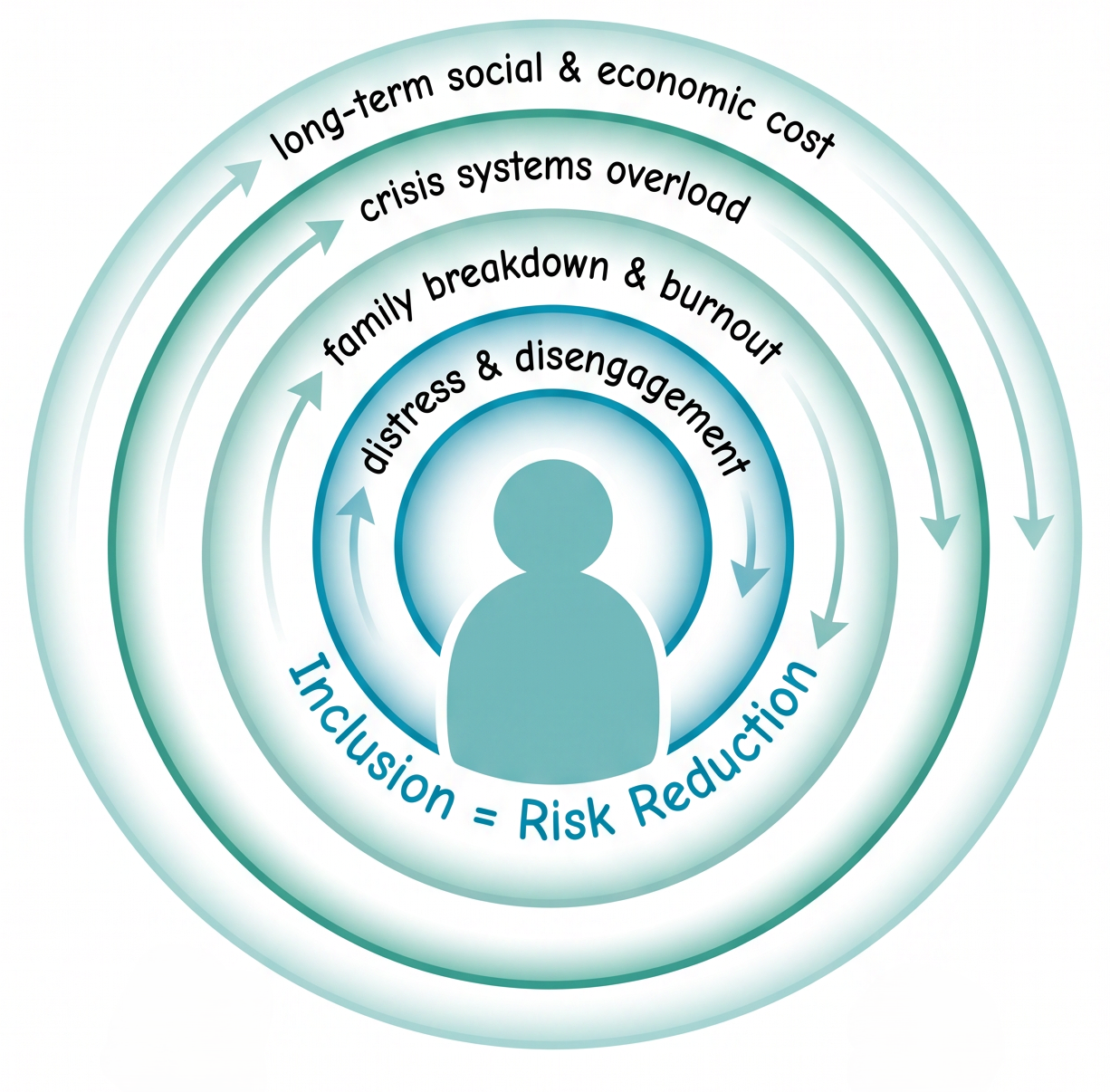
When inclusion is not prioritised, the impacts extend far beyond the individual.
For Individuals & Families
Mental health challenges
Burnout and carer fatigue
Social isolation
Reduced educational engagement
Reduced employment participation
Increased stress and anxiety
Greater crisis vulnerability
For Schools & Services
Increased behavioural escalation
Higher staff stress and turnover
More complaints and conflict
Greater reliance on reactive practices
Reduced trust with families and communities
For Communities & Systems
Increased pressure on health and crisis services
Reduced workforce participation
Greater long-term economic costs
Increased inequity and exclusion
Loss of community connection and belonging
Inclusion Creates Stronger Communities
Inclusive organisations are often:
more adaptable,
more innovative,
more community connected,
and better equipped to respond to change.
When people feel:
safe,
understood,
valued,
and supported,
they are more likely to:
participate,
contribute,
remain engaged,
and thrive within their communities.
This benefits everyone.
A Shift in Perspective
As sectors continue navigating reform, workforce pressures, and increasing complexity, we need to broaden the conversation around risk.
Instead of only asking:
“How do we reduce risk by limiting support or participation?”
we should also be asking:
“How do we reduce risk by increasing inclusion, accessibility, connection, and belonging?”
Because inclusion is not simply a social ideal.
It is a long-term investment in wellbeing, sustainability, participation, and community resilience.
Written from a neuroaffirming, human rights, and community inclusion perspective by The Inclusive Movement