Disability Inclusion in Practice: How to Move Beyond Compliance to True Workplace and School Belonging
Disability inclusion is the deliberate practice of designing workplaces, schools, and community environments so that people with disability can participate fully, safely, and autonomously. True inclusion moves beyond statutory compliance checklists or retroactive adjustments for an individual. It requires a fundamental shift toward creating identity-affirming spaces that anticipate diverse human needs and remove attitudinal, systemic, and physical barriers from the outset.
Historically, organisations have treated accessibility as an administrative hurdle, responding only when an individual requests an accommodation or when a policy requires a minimum level of compliance. This reactive model views disability through a deficit lens, framing the individual as someone who needs to be accommodated rather than recognising that the environment itself is what causes the restriction. By adopting a proactive design philosophy, leaders can build systems where accessibility is woven into the core infrastructure of the organisation, ensuring that every employee, student, or visitor experiences a genuine sense of structural belonging.
The Current Landscape of Disability Diversity in Australia
Modern workforce strategies across Australia frequently group all equity initiatives into a singular, generalised corporate framework. While this broad approach aims to address systemic inequality, it often results in disability being treated as an administrative afterthought within standard human resource reporting. When organisations conflate vastly different community barriers under a single generic banner, the distinct structural and attitudinal obstacles faced by people with disability remain unaddressed, unmeasured, and unchanged.
Achieving genuine representation across all levels of leadership requires organisations to look beyond high-level headcount statistics and focus deliberately on disability diversity as an independent operational pillar. Without standalone frameworks that explicitly evaluate digital accessibility, environmental adjustments, and psychological safety, standard reporting mechanisms will continue to mask the actual gaps in economic and workplace participation. Systemic progress only occurs when leadership teams stop viewing accessibility through a narrow compliance lens and begin investing in intentional, long-term strategies tailored to the real-world experiences of disabled professionals.
Navigating the Shift in Australian Classrooms: Beyond the Inclusion Profile
Across Australian educational environments, conversations around accessibility are currently dominated by complex administrative and funding frameworks. School principals and leadership teams invest immense organisational energy into navigating systems like the Victorian Department of Education's Disability Inclusion Profile or various state-based disability inclusion funding modules. While these structured assessment tools are essential for securing vital resources and staffing allocations, an over-reliance on compliance paperwork can create a situation where meeting a bureaucratic threshold is mistaken for achieving true classroom accessibility. Documenting a student's support needs on paper does not automatically guarantee that they will experience a genuine sense of safety and belonging when they walk through the school gates each morning.
To create environments where neurodivergent and disabled students genuinely thrive, school leaders must look beyond the compliance checklist and implement everyday inclusive work practices that transform the school culture. This means moving away from rigid, deficit-focused interventions and embedding flexible, relational support systems that actively honour student voice and value the neurodivergent experience. When a teaching team receives practical disability awareness training, they learn to move past standard behavioural management strategies and instead design learning spaces that adapt to a student's unique nervous system. By prioritising authentic identity acceptance and environmental adjustments over mere performance conformity, educational communities can bridge the gap between administrative funding and a lived reality of genuine school belonging.
Rethinking Corporate Cultures: Designing Sustainable Workplace Adjustments
Traditional structural models treat employment accommodations as exceptional, reactive measures triggered only by a formal disclosure or a strict legal necessity. This approach creates unnecessary organisational friction, forcing professionals to navigate bureaucratic hurdles simply to obtain the foundational tools required to perform their roles. True structural transformation involves shifting corporate culture so that flexible environmental modifications are treated as a standard operational norm. When a business integrates accessibility into its baseline infrastructure, providing varied communication pathways and adaptable physical spaces becomes as routine as issuing standard technology or office hardware.
Normalising practical workplace adjustments across an entire organisation directly reduces the immense psychological load of employee masking, where individuals expend vital cognitive energy concealing their support needs to survive an inflexible environment. Over time, the pressure to mask one's natural processing style or sensory requirements leads to systemic professional burnout, which heavily fractures team retention and reduces long-term operational capacity. By proactively embedding reasonable workplace adjustments (such as quiet zones, sensory-friendly lighting options, and flexible workflows) organisations remove the heavy burden of individual self-advocacy. This cultural shift naturally builds a safer, highly efficient operational ecosystem where teams can direct their focus away from masking and toward sustainable, high-impact contributions.
Dismantling "Inclusion Theatre" in Modern Organisations
Many workplace initiatives inadvertently default to what can be described as "Inclusion Theatre." This occurs when an organisation relies heavily on superficial awareness milestones, tokenistic policy updates, or calendar-driven celebrations while leaving deeply entrenched, inaccessible barriers entirely untouched. For example, hosting a morning tea for an awareness day or publishing an inspirational statement creates a temporary illusion of progress, yet it does nothing to alter the daily reality of employees who still cannot navigate the digital infrastructure or physical layout of their workplace. True progress is stalled when the appearance of allyship is prioritised over the uncomfortable, necessary work of structural reform.
Moving past this performative stage requires a profound shift from passive awareness to active, structured accountability across all levels of leadership. True disability inclusion is not achieved by treating disability awareness training as a standalone checkbox exercise or an annual compliance audit. It demands an ongoing willingness to evaluate systemic power structures, redesign operational environments, and establish measurable benchmarks for accessibility. At The Inclusive Movement, our lived experience drives our understanding that performative gestures offer no comfort to a person facing daily exclusion, which is why real cultural change happens only when leadership teams commit to long-term, sustainable practices that guarantee every individual structural belonging.
Moving from Awareness to Action: The Value of a Structured Disability Inclusion Program
True structural change begins when an organisation moves away from ad hoc accommodations and commits to a formalised disability inclusion program. This systematic approach shifts the operational burden away from the disabled individual, establishing sustainable implementation models that adapt the environment to fit the person rather than demanding that the person alter their identity to survive an inaccessible system. By building a foundational culture of access, companies and educational institutions replace rigid compliance paradigms with flexible, long-term operational systems that natively support diverse processing styles and physical requirements.
Designing these sustainable frameworks requires direct engagement with lived experience expertise to ensure that structural updates genuinely reflect the practical needs of the disabled community. Consulting with practitioners who possess both personal and professional insight prevents organisations from falling back into performative policy design or superficial checklist audits. Incorporating targeted disability awareness training into an organisation-wide rollout empowers leadership teams to identify invisible barriers and establish clear, measurable benchmarks for structural belonging.
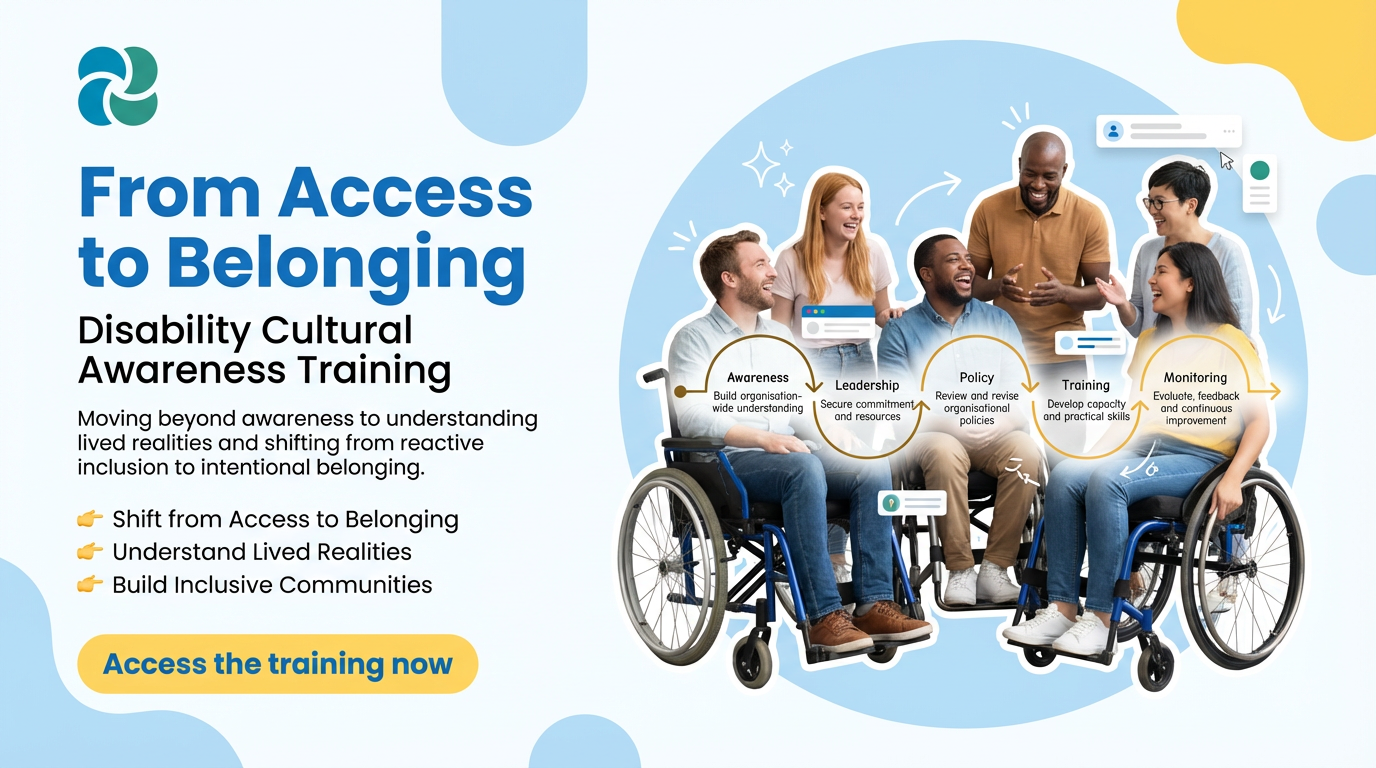
To bridge the gap between administrative intent and daily workplace reality, The Inclusive Movement delivers our signature From Access to Belonging training. This specialised disability cultural awareness training moves teams entirely beyond passive awareness, focusing instead on deeply understanding lived realities and shifting from reactive inclusion to intentional belonging. By participating in this professional development programme, individuals learn how to transform their immediate environments, respect student or employee autonomy, and build genuinely inclusive communities from the ground up.
Choosing the Right Disability Awareness Training Partner
Selecting a professional development partner is a critical step for organisations ready to translate policy into everyday practice. Through the Inclusive Training Hub, we deliver our signature From Access to Belonging training, a dedicated disability cultural awareness programme designed specifically for corporate teams and educational leadership. By moving past rigid legislative checklists and performative milestones, this training equips leaders with the practical tools necessary to transition their environments from basic physical access to profound, structural belonging.
What sets our approach apart is the deliberate integration of lived-experience consulting into every stage of delivery. Hearing directly from practitioners who navigate these attitudinal and systemic barriers daily provides your team with professional insights that an academic or compliance-driven framework simply cannot replicate. Participants in this programme learn to move beyond superficial compliance, gain a profound understanding of lived realities, and walk away with an actionable roadmap to build truly inclusive communities.
Achieving true disability inclusion requires a long-term commitment to operational accountability and cultural evolution. Investing in targeted disability awareness training ensures that your leadership teams are equipped to replace performance-driven conformity with genuine environmental accessibility. We invite human resource managers, school principals, and team leaders to book a professional consultation or secure a customised From Access to Belonging workshop through The Inclusive Movement today.
Frequently Asked Questions About Disability Inclusion
-
Disability awareness focuses on acknowledging and understanding that disabilities exist within our communities. In contrast, disability inclusion is the active, ongoing practice of restructuring environments, organisational policies, and systemic attitudes to ensure individuals with disability have equal access, authentic belonging, and complete autonomy. True inclusion means individuals do not have to hide who they are or mask their support needs in order to participate fully and be accepted.
-
Beyond meeting standard ethical and regulatory requirements under Australian law, prioritising disability inclusion shifts workplace cultures away from rigid performance compliance toward sustainable occupational wellness. When businesses intentionally embed accessible design from the outset, they eliminate systemic physical and social barriers that typically hinder staff. This proactive approach significantly reduces employee burnout and naturally improves long-term retention rates across the entire workforce.
-
Practical examples include offering flexible working hours, designing sensory-friendly workspaces, providing assistive technology tools, modifying physical layouts for seamless accessibility, and diversifying communication formats. Rather than applying a generic template, effective workplace adjustments focus on modifying environments and workflows to match an individual's unique nervous system and functional capacity. These customisations ensure that professionals can work sustainably without facing unnecessary structural friction.
-
While administrative tools like state funding profiles are necessary for resource allocation, true classroom inclusion requires moving away from deficit-focused tracking models toward strength-based, interest-led education. School communities can achieve this by applying universal design frameworks that assume and welcome diverse learning styles right from the beginning. This shift involves deeply respecting student autonomy and ensuring educators receive practical training grounded in identity acceptance and relational support.
-
High-impact disability awareness training must move past superficial legal definitions, generic compliance checklists, or performative corporate gestures. Effective professional development incorporates lived-experience perspectives to provide leadership teams with deep insight into daily inclusive work practices. The curriculum should deliver a clear, actionable roadmap for implementing workplace adjustments, empowering teams to replace rigid compliance with genuine environmental and cultural accessibility.